Provenance
Probably given by the artist to Vallin [inscription]. Eric Estorick (1913–1993), London, by April 1960 [Eindhoven 1960]. Roland, Browse and Delbanco Gallery, London [Milan 1961 auct. cat.]. Sold, Finarte, Milan, November 22, 1961, lot 115. Lester Avnet (died 1970), New York [correspondence in curatorial file]. Harkus Krakow Gallery, Boston, to Dorothy Braude Edinburg; give to the Art Institute, 1998
Accession Number
150819
Medium
Graphite on cream wove paper
Dimensions
41.7 × 27.2 cm (16 7/16 × 10 3/4 in.)
Classification
graphite
Credit Line
Gift of Dorothy Braude Edinburg to the Harry B. and Bessie K. Braude Memorial Collection
Background & Context
Background Story
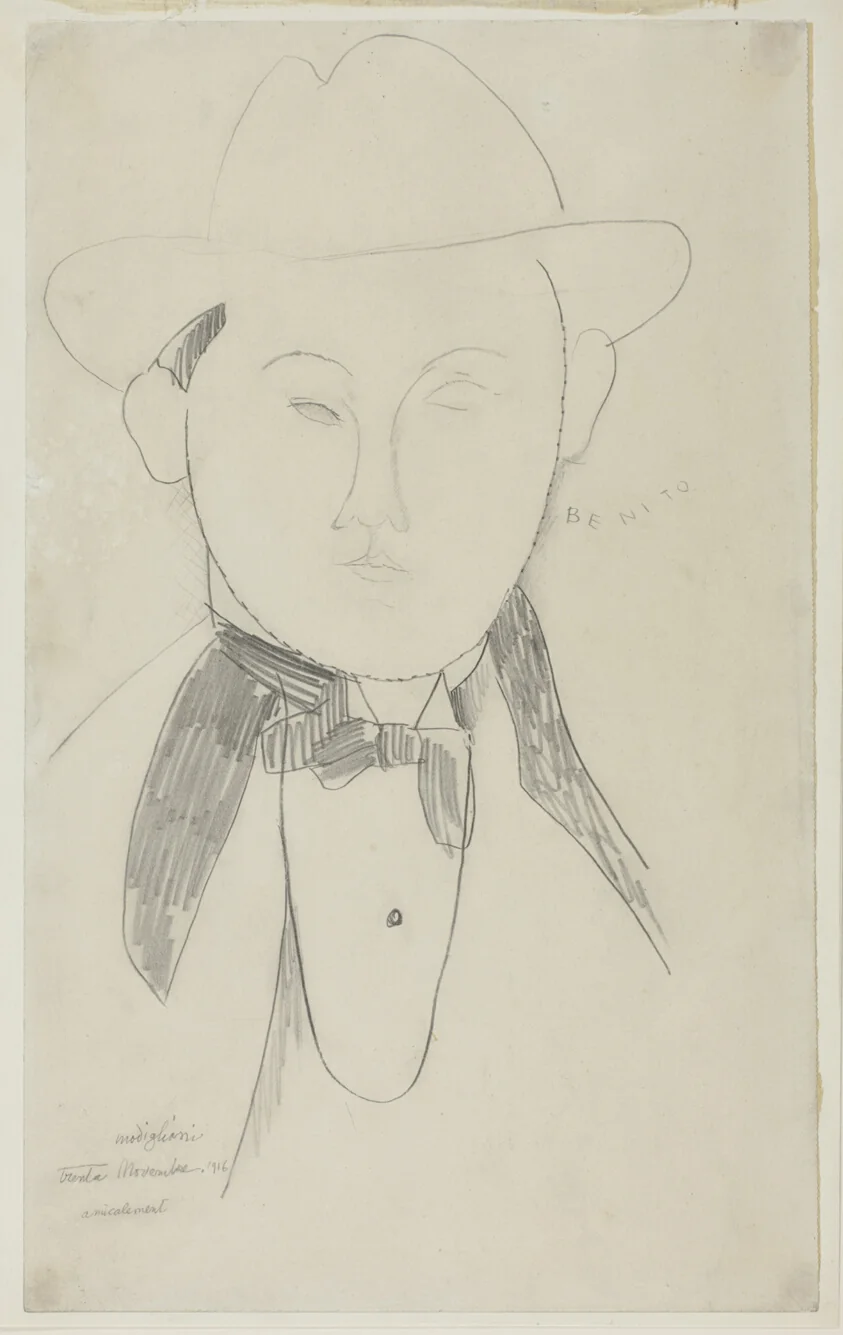
Amedeo Modigliani's "Portrait of Vallin" (1918) is a graphite drawing depicting a man named Vallin, likely a friend or acquaintance from Modigliani's circle in the South of France, where the artist lived in 1918–19. By 1918, Modigliani had moved south to Nice and Cagnes-sur-Mer with Jeanne Hébuterne, escaping the wartime hardships of Paris and seeking a healthier climate. The change of scenery did not alter his distinctive style—the portrait of Vallin shows all the characteristic Modigliani hallmarks: the elongated head, the simplified features, the elegant economy of line. But there is perhaps a greater softness in these later drawings, a slight relaxation of the intensity that marks his Paris work. The sitter's features are rendered with sensitivity and respect, suggesting a genuine connection between artist and subject. Modigliani's portrait drawings from his final years are particularly poignant, created with the knowledge that his health was deteriorating rapidly. He died just two years later, leaving behind a body of work that would make him one of the most celebrated artists of the 20th century, though he experienced little commercial success during his lifetime.
Cultural Impact
Modigliani's late drawings, created in the shadow of his declining health, show no diminution of his powers—if anything, they gain a new tenderness and depth of human feeling.
Why It Matters
This portrait of an otherwise forgotten figure is a testament to Modigliani's unwavering artistic vision, a face rescued from anonymity by the artist's gift for finding the universal in the particular.