Provenance
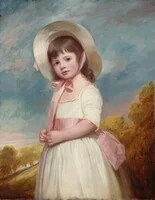
Painted for the sitter's father, Sir Christopher Willoughby, Bt. [1748-1808], Baldon House, Oxfordshire; by descent to Sir John Willoughby, 5th Bt.,[1] Fulmer Hall, Slough, Buckinghamshire; sold 1906 to (M. Knoedler & Co., London and New York); purchased February 1907 by Andrew W. Mellon, Pittsburgh and Washington, D.C.; deeded 28 December 1934 to The A.W. Mellon Educational and Charitable Trust, Pittsburgh; gift 1937 to NGA.
[1] The 2nd through 4th Baronets Willoughby added to the former owner table in the NGA collection database are per The Getty Provenance Index, which lists these baronets each with the symbol (?), indicating some doubt as to the painting's direct passage through these three succeeding brothers down to the 5th Bt.
Accession Number
1937.1.104
Medium
oil on canvas
Dimensions
overall: 92.1 x 71.5 cm (36 1/4 x 28 1/8 in.)
Classification
Painting
Credit Line
Andrew W. Mellon Collection
Tags
Painting Neoclassical & Romantic (1751–1850) Oil Painting Canvas British Color: White Color: Gray
Background & Context
Background Story
George Romney's portrait of Miss Juliana Willoughby (1781-1783) exemplifies the artist's distinctive approach to female portraiture that made him the most fashionable portraitist in late 18th-century London after Reynolds and Gainsborough. Romney, who avoided the Royal Academy and its politics, built his career through commercial success with a clientele that valued his ability to combine elegance with psychological freshness. Miss Willoughby, likely a young woman of the gentry or professional class, is depicted at the moment of entering society—the transition from childhood to adult social life that was one of portraiture's most significant functions. The 1781-83 date places this during Romney's most productive period, when his studio on Cavendish Square was producing portraits at a rate that rivaled any London painter. Romney's approach to young women's portraiture was characteristically sympathetic: he found energy and intelligence in his sitters rather than mere decorative beauty. His brushwork, more fluent and less labored than Reynolds's, creates an effect of spontaneity that suggests the sitter's living presence rather than a carefully constructed artistic performance. The portrait also reflects the 1780s social context: a period of cultural confidence in Britain before the French Revolution disrupted European social structures.
Cultural Impact
Romney's female portraits influenced how young women were represented in British art, establishing conventions of elegance and intelligence that distinguished his work from more purely decorative approaches. His portraits influenced fashion—sitters often chose Romney because his style complemented contemporary dress—and influenced later Regency portraiture that similarly valued freshness over formality. The portraits also influenced how the 1780s were visually remembered, creating a visual record of pre-Revolutionary British society at its most confident.
Why It Matters
This portrait matters because it captures a specific moment in a young woman's life—the transition to social adulthood—with a psychological acuity that makes the image feel alive rather than merely recorded. Romney's Miss Willoughby is not a type but a person, distinguished by the alertness and intelligence that Romney consistently found in his best sitters. For contemporary viewers, the portrait offers a window into the social rituals of 18th-century British life while demonstrating enduring principles of portraiture.