Provenance
Painted for the sitter's husband, Alexander Blair, Castle Bromwich, Warwickshire. William Beckett-Denison [1826-1890], Nun Appleton, Yorkshire; by descent to his son, Ernest William Beckett [1856-1917], later 2nd Baron Grimthorpe; (sale, Christie, Manson & Woods, London, 23 May 1903, no. 80); purchased by (Charles Sedelmeyer, Sedelmeyer Gallery, Paris); sold to (Eugene Fischhof); purchased 4 April 1907 by P.A.B. Widener, Lynnewood Hall, Elkins Park, Pennsylvania; inheritance from estate of Peter A.B. Widener by gift through power of appointment of Joseph E. Widener, Elkins Park; gift 1942 to NGA.
Accession Number
1942.9.77
Medium
oil on canvas
Dimensions
overall: 127 x 101.5 cm (50 x 39 15/16 in.) | framed: 161.3 x 134 x 10.8 cm (63 1/2 x 52 3/4 x 4 1/4 in.)
Classification
Painting
Credit Line
Widener Collection
Tags
Painting Neoclassical & Romantic (1751–1850) Oil Painting Canvas British Color: Gold
Background & Context
Background Story
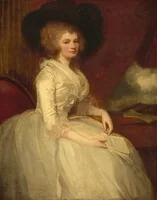
Mrs. Alexander Blair (1787-1789) represents Romney's mature approach to married women's portraiture, depicting a sitter whose identity is defined partly through her marital relationship—the convention of identifying married women through their husbands was universal in 18th-century Britain. The portrait dates from the late 1780s, a period when Romney was increasingly absorbed by his literary and artistic interests—including his fascination with Emma Hart (later Lady Hamilton), who became his most frequent model. Despite these distractions, Romney continued to produce accomplished society portraits that maintained the technical standards his clientele expected. Mrs. Blair's portrait likely demonstrates Romney's ability to combine conventional representation with personal insight—she is identified through her marriage but revealed as an individual. The late 1780s context is significant: the French Revolution began in 1789, and British society was about to be transformed by decades of war and political change. Romney's portrait captures the late Georgian world just before its disruption—a moment of social confidence and cultural elegance that the Napoleonic Wars would alter fundamentally.
Cultural Impact
Romney's late portraits influenced how the transition from Georgian to Regency society was visualized, documenting the final phase of 18th-century British portraiture before Napoleonic-era changes transformed British social life. The portraits influenced how married women's identity was represented, establishing conventions of dignified femininity that would persist through the Victorian era. The Mrs. Blair portrait specifically contributed to the visual record of British professional and gentry families.
Why It Matters
This portrait matters because it captures the end of an era—the late Georgian period—just before the French Revolution and Napoleonic Wars transformed British society. Mrs. Alexander Blair represents a world of social stability and cultural confidence that would be severely tested in the following decades. The portrait thus carries historical poignance alongside its artistic achievement.