Provenance
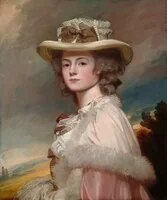
Painted for the sitter's husband, Davies Davenport [1757-1837], Capesthorne, Macclesfield, Cheshire; by descent to Sir William Bromley-Davenport [1862-1949];[1] (sale, Christie, Manson & Woods, London, 28 July 1926, no. 147); (Duveen Brothers, Inc. London, New York, and Paris); purchased April 1928 by Andrew W. Mellon, Pittsburgh and Washington, D.C.; deeded December 1934 to The A.W. Mellon Educational and Charitable Trust, Pittsburgh; gift 1937 to NGA.
[1] The additions of "Davenport family" and William Bromley-Davenport to the former owner table in the NGA collection database are per The Getty Provenance Index, and NGA curatorial files. The Getty Provenance Index, whose source was their Collector's File, says the painting was bequeathed to the third son of Davies Davenport, The Rev. Walter Bromley-Davenport [1787-1862], and by him to his son, William Bromley-Davenport [1821-1884], who succeeded his cousin, Arthur Henry Davenport [1832-1867]. Davies Davenport's eldest son and successor in the family estate was Edward Davies Davenport [1778-1847], father of Arthur Henry. It is thus also possible that the painting was passed through Edward down to Sir William Bromley-Davenport.
Accession Number
1937.1.105
Medium
oil on canvas
Dimensions
overall: 76.5 x 64 cm (30 1/8 x 25 3/16 in.) | framed: 104.1 x 91.4 x 12.7 cm (41 x 36 x 5 in.)
Classification
Painting
Credit Line
Andrew W. Mellon Collection
Tags
Painting Neoclassical & Romantic (1751–1850) Oil Painting Canvas British Color: Orange Color: Brown
Background & Context
Background Story
Romney's portrait of Mrs. Davies Davenport (1782-1784) depicts a member of the landed gentry whose family had been established in Cheshire since the medieval period. The Davenports were among the county families that formed the backbone of British political and social life—the Parliamentary representatives, local magistrates, and social leaders who governed Britain below the aristocratic level. Mrs. Davenport's portrait exemplifies Romney's ability to combine social authority with personal presence: she is depicted as a woman of consequence without sacrificing her individual character to social type. The 1782-84 date places this during the period when Britain was recovering from the American Revolutionary War and navigating the beginning of industrial transformation. Mrs. Davenport represents the stable, rural England that industrialization would progressively transform—a world of country houses, county society, and the seasonal rhythms of agricultural life. Romney's handling combines the fluency of his best work with a formality appropriate to the sitter's social position—the brushwork is slightly more controlled than in his portraits of younger women, reflecting a maturity in both artist and sitter.
Cultural Impact
Romney's portraits of county society women influenced how the British gentry was visually represented, establishing conventions of dignified femininity that persisted through the 19th century. The portraits documented the material culture of the landed gentry—their dress, their settings, their self-presentation—and influenced how rural British society was culturally understood. The Davenport portrait specifically contributed to the visual record of Cheshire gentry families.
Why It Matters
This portrait matters because it documents a specific segment of 18th-century British society—the county gentry—that was both socially essential and visually underrepresented compared to the aristocracy. Romney's Mrs. Davenport represents the class that governed rural Britain, making the portrait a document of political as well as artistic significance. For contemporary audiences, it illuminates the social structures that supported the British political system.