Provenance
Painted for the sitter's husband, the Hon. Edward Ward [1753-1812], son of Bernard, 1st Viscount Bangor; by descent to Maxwell, 6th Viscount Bangor [1868-1950], Castle Ward, County Down. (M. Knoedler & Co., New York); purchased 1921 by Joseph E. Widener, Lynnewood Hall, Elkins Park, Pennsylvania; inheritance from Estate of Peter A.B. Widener by gift through power of appointment of Joseph E. Widener, Elkins Park, after purchase by funds of the Estate; gift 1942 to NGA.
[1] The additional Viscounts Bangor listed in the former owner table in NGA's collection database are per The Getty Provenance Index.
Accession Number
1942.9.78
Medium
oil on canvas
Dimensions
overall: 76 x 63.5 cm (29 15/16 x 25 in.)
Classification
Painting
Credit Line
Widener Collection
Tags
Painting Neoclassical & Romantic (1751–1850) Oil Painting Canvas British
Background & Context
Background Story
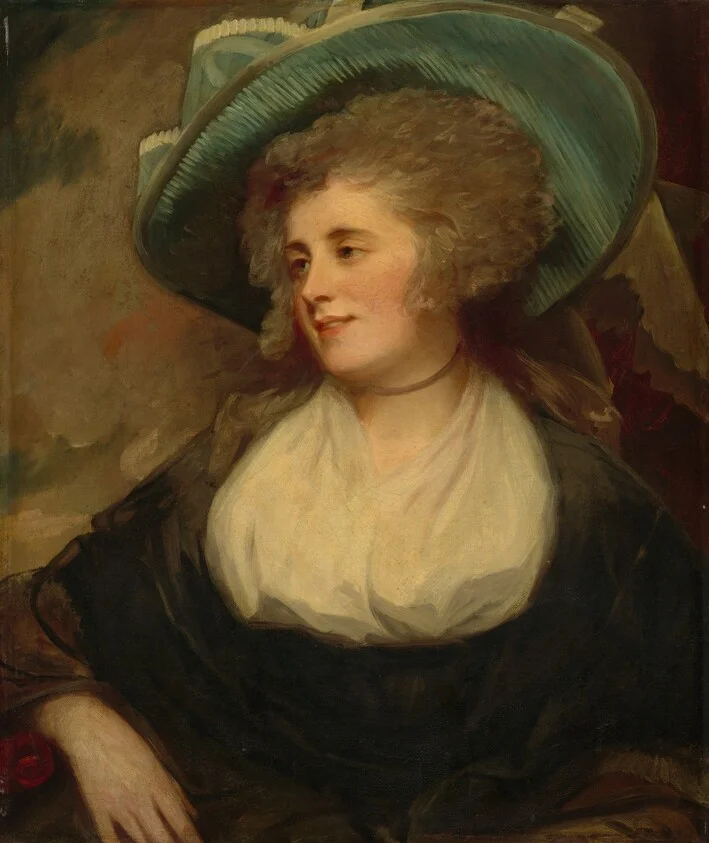
Lady Arabella Ward (1783-1788) is a portrait of aristocratic rank—Lady Ward's title indicates her marriage into the titled aristocracy, making this portrait an example of Romney's engagement with the highest social tier. Romney, though commercially successful, was never fully accepted by the Royal Academy establishment and maintained an ambivalent relationship with aristocratic patronage. His portrait of Lady Ward likely reflects this ambivalence: the technical accomplishment is complete, yet the approach may be less deferential than aristocratic convention demanded. The 1783-88 date spans several years, suggesting either a prolonged sitting process or Romney's characteristic difficulty in completing commissions. His procrastination with portraits—leaving them unfinished for extended periods—was well known and may have reflected his discomfort with the purely commercial dimension of portrait practice. Lady Ward's depiction combines the social authority of her rank with the psychological immediacy that distinguishes Romney's best work. His ability to render rank without subservience—treating aristocratic sitters with the same perceptual honesty he brought to all subjects—is what separates his portraiture from mere fashionable production.
Cultural Impact
Romney's aristocratic portraits influenced how the British peerage was represented visually, providing alternatives to the more formal conventions established by Reynolds. His approach influenced later portraitists who similarly sought to combine social authority with personal vitality. The portraits also documented the visual culture of the 18th-century aristocracy—their dress, their settings, and their self-image—for future generations.
Why It Matters
This portrait matters because it demonstrates Romney's ability to navigate the social hierarchies of 18th-century Britain while maintaining his artistic independence. Lady Ward receives a portrait that acknowledges her rank without being defined by it—the same perceptual honesty that served Romney's middle-class sitters also served his aristocratic ones. For contemporary artists navigating client relationships, Romney's approach offers a model for maintaining artistic standards while serving diverse social constituencies.