Provenance
Kraushaar Gallery, New York [according to E.V. Thaw invoice in curatorial file]. Thomas Edward Hanley (died 1969), Bradford, Penn., by 1957 [Philadelphia 1957]. Sold by E. V. Thaw and Company, New York, to Mrs. Wesley Dixon, Jr., Lake Forest, Ill., November 15, 1966 [invoice]; given to the Art Institute, 1967.
Accession Number
26728
Medium
Pen and brown and black ink, over graphite on tan wove paper, laid down on buff wove card
Dimensions
26.6 × 20.7 cm (10 1/2 × 8 3/16 in.)
Classification
pen and ink drawings
Credit Line
Purchased with funds provided by Mr. and Mrs. Wesley M. Dixon, Jr.
Background & Context
Background Story
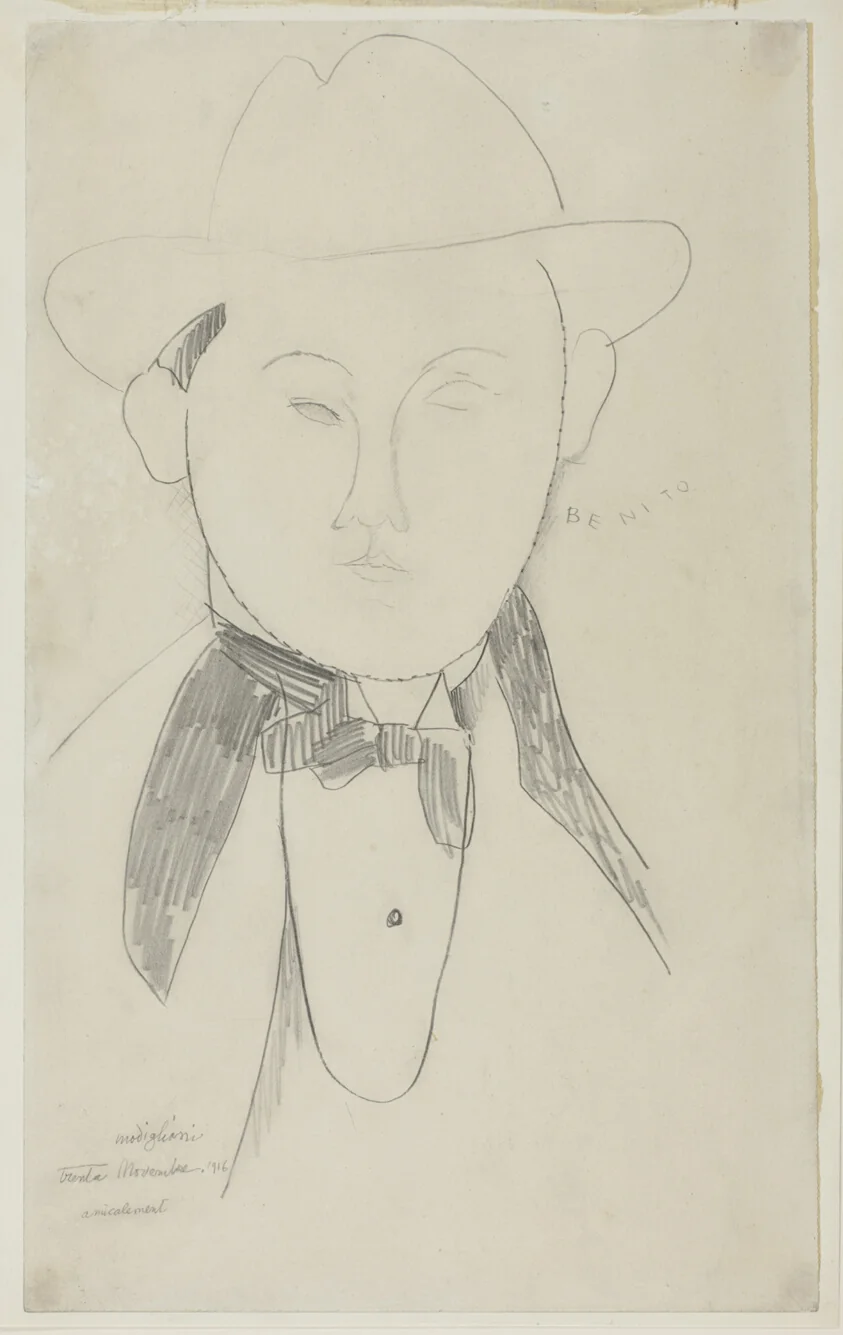
Amedeo Modigliani's "Diego Rivera" (1915) is a pen and ink portrait of the famous Mexican muralist, executed in brown and black ink over graphite on tan wove paper. This drawing captures Rivera (1886–1957) during his Paris years, before he became the world-famous muralist of the Mexican Renaissance. At this time, Rivera was part of the vibrant community of artists in Montparnasse, experimenting with Cubism and developing his distinctive style. Modigliani and Rivera were friends and drinking companions, part of the same bohemian circles that included Picasso, Brancusi, and Apollinaire. The portrait is striking in its directness: Rivera's robust features, his prominent nose, his confident bearing are all captured with Modigliani's economical but expressive line. The pen-and-ink medium gives the drawing a crispness and immediacy that differs from Modigliani's softer graphite works. This drawing is historically significant as a document of the friendship between two artists who would define the art of their respective nations—Modigliani as Italy's modernist master and Rivera as Mexico's greatest muralist.
Cultural Impact
This portrait documents a crucial intersection in modern art history: the encounter between the European modernist tradition and the Latin American artistic renaissance that Rivera would spearhead upon his return to Mexico.
Why It Matters
Modigliani's portrait of the young Rivera captures the future muralist at a formative moment, before fame and revolution transformed him into a global icon, showing the human face behind the legend.