Provenance
George Gund III [1937-2013], ?-2015, bequest to the Cleveland Museum of Art (?-2015); The Cleveland Museum of Art, Cleveland, OH, 2015-present (2015-)
Accession Number
2015.504
Medium
six-panel folding screen; ink, color, and gold on paper
Dimensions
Painting only: 143.2 x 334 cm (56 3/8 x 131 1/2 in.); Overall: 159.9 x 348.8 cm (62 15/16 x 137 5/16 in.)
Classification
Painting
Credit Line
Gift from the Collection of George Gund III
Tags
Painting Baroque (1600–1750) Ink Panel Painting Gold Leaf Paper Color: Gold
Background & Context
Background Story
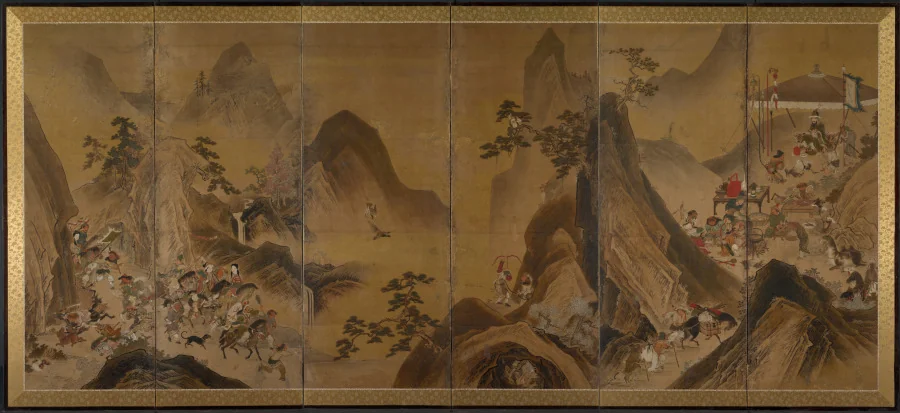
Tartars Hunting in a Mountain Landscape from the first half of the 1600s is an anonymous Chinese painting depicting Central Asian horsemen hunting in a mountain landscape, a subject that reflects the Chinese court's interest in the nomadic peoples of the northern steppes during the Ming-Qing transition period. The first half of the 1600s was a period of political upheaval in China, as the Ming dynasty was overthrown by the Manchu Qing dynasty in 1644, and paintings of Tartar hunting subjects reflect the Chinese court's awareness of the military power of the nomadic peoples to the north.
Cultural Impact
Tartars Hunting in a Mountain Landscape is important in the history of Chinese painting because it demonstrates the court's interest in the nomadic peoples of the northern steppes during the Ming-Qing transition period. The subject of Tartar hunting—depicting Central Asian horsemen in mountain landscapes—was a popular court subject that reflected the political realities of the period, when the nomadic peoples of the north were becoming an increasing threat to the Chinese court.
Why It Matters
Tartars Hunting in a Mountain Landscape is an anonymous Chinese painting reflecting the court's awareness of northern nomadic power: Central Asian horsemen hunting in mountains during the politically turbulent first half of the 1600s. The painting shows how Chinese court painting engaged with the political realities of the Ming-Qing transition period.