Description
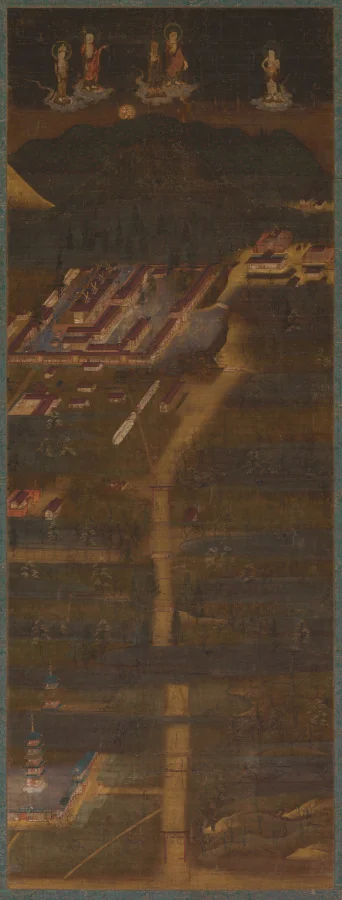
A golden path beginning at the bottom of this painting leads up to four red-and-white buildings to the left, then to a fifth building on the right. These are the five shrine halls of Kasuga Taisha in Nara. Above and beyond the buildings is a sacred mountain range––with Mount Mikasa at center, Mount Wakakusa in gold to the left, and the sun or moon rising up behind the mountains. Sacred deer appear here and there. Five figures representing the original Buddhist forms of the five kami of the shrine complex stand on clouds above the mountains.
Provenance
Private Collection, Japan (before 1978); (Tokyo Art Club auction, Tokyo, Japan, sold to Mr. Tajima of London Gallery); (London Gallery, Ltd., Tokyo, Japan, sold to the Cleveland Museum of Art) (?–2015); The Cleveland Museum of Art, Cleveland, OH (2015–)
Accession Number
2015.137
Medium
Hanging scroll; ink, color, and gold on silk
Dimensions
Overall: 193.6 x 58.8 cm (76 1/4 x 23 1/8 in.); Painting only: 110 x 40.9 cm (43 5/16 x 16 1/8 in.)
Classification
Painting
Credit Line
Leonard C. Hanna Jr. Fund
Tags
Painting Medieval (500–1399) Ink Silk Painting Gold Leaf Color: Orange
Background & Context
Background Story
Kasuga Shrine Mandala, created in the early 1300s during the Kamakura period, is a Buddhist devotional painting depicting the sacred precincts of the Kasuga Grand Shrine in Nara, Japan. The mandala format, which presents the shrine and its surrounding landscape as a sacred geography, was a major form of religious art in medieval Japan, used to facilitate worship for those unable to make the pilgrimage to the shrine itself.
The Kasuga Shrine, dedicated to the tutelary deities of the powerful Fujiwara clan, was one of the most important religious sites in medieval Japan. Its mandalas, produced in large numbers by workshop painters, were among the most widely distributed religious images of the Kamakura period. Each mandala follows a convention that maps the shrine buildings, the deer that inhabit the precincts, and the surrounding Mount Mikasa onto a vertical format that places the divine above and the earthly below.
The painting most distinctive quality is its combination of architectural precision and atmospheric evocation. The shrine buildings are rendered in the yamato-e style with careful attention to architectural detail, while the mountain behind is painted in the softer ink-wash technique borrowed from Chinese landscape painting. The deer, believed to be messengers of the Kasuga deities, move freely through the sacred precincts, connecting the human architecture with the natural landscape that was itself considered divine.
Cultural Impact
Kasuga Shrine mandalas are among the most important surviving documents of medieval Japanese religious practice and the visual culture of shrine Buddhism. Their mapping of sacred space influenced the development of Japanese religious art and the tradition of meisho-e (famous-place painting) that would become a major genre in the Edo period.
Why It Matters
This mandala captures the essence of Japanese sacred geography: a landscape in which every element - the shrine, the mountain, the deer, the trees - participates in a divinely ordered whole. The painting is not a representation of sacred space but an embodiment of it - a portal through which worship at a distance becomes worship in the presence of the divine.