Accession Number
1915.107
Medium
hanging scroll, ink and slight color on silk
Dimensions
Overall: 169.2 x 95.9 cm (66 5/8 x 37 3/4 in.)
Classification
Painting
Credit Line
Gift of Charles L. Freer
Tags
Painting Baroque (1600–1750) Ink Silk Painting Color: Gold
Background & Context
Background Story
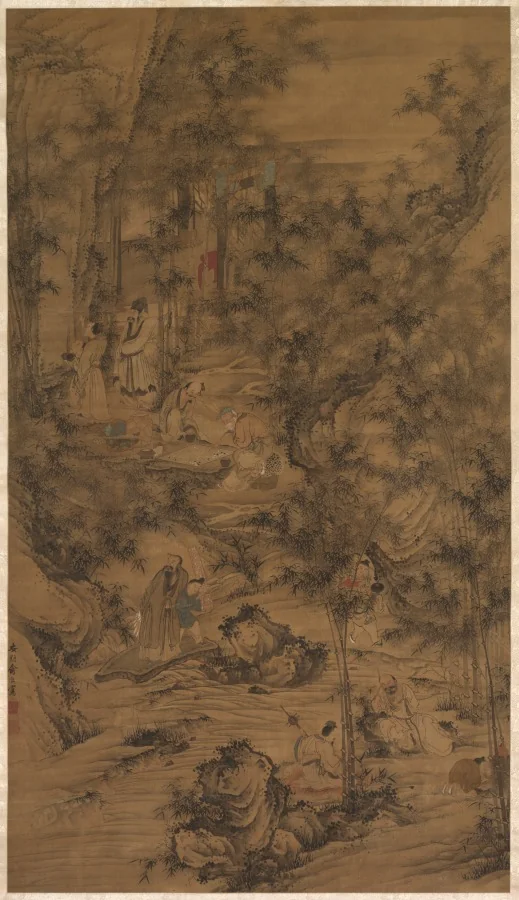
The Seven Worthies of the Bamboo Grove, created during the Qing dynasty (1644-1911), depicts the legendary group of scholars, poets, and musicians who withdrew from public life during the turbulent Three Kingdoms period (3rd century CE) to pursue philosophy, art, and friendship in a bamboo grove. The subject, one of the most enduring themes in Chinese painting, embodies the ideal of the literatus who chooses personal integrity over political engagement.
The Seven Worthies - Ji Kang, Ruan Ji, Shan Tao, Xiang Xiu, Liu Ling, Wang Rong, and Ruan Xian - were historical figures who became cultural archetypes. Their refusal to serve corrupt governments and their devotion to music, poetry, and Daoist philosophy made them models of the Chinese scholar-official ideal. The bamboo grove itself became a symbol of moral integrity: bamboo, which bends but does not break, was the natural emblem of the literatus who maintains his principles under political pressure.
This Qing dynasty version exemplifies the tradition of historical figure painting that was central to the Chinese literati tradition. The artist renders each worthy as a distinct personality, their postures and activities - playing the qin, drinking wine, composing poetry, or simply contemplating nature - defining their individual character within the collective ideal of reclusion and friendship.
Cultural Impact
The Seven Worthies of the Bamboo Grove established the most enduring archetype in Chinese cultural history: the scholar who chooses integrity over advancement. Their influence on Chinese literature, painting, and philosophy extended through every subsequent dynasty and shaped the ideal of the literatus that defined Chinese elite culture for two millennia.
Why It Matters
This painting captures the most Chinese of ideals: the conviction that the highest form of human achievement is not political power but personal integrity, and that the bamboo grove - a place of friendship, philosophy, and art - is more valuable than the palace. The Seven Worthies, ancient and modern, are the permanent alternative to every corrupt regime.