Description
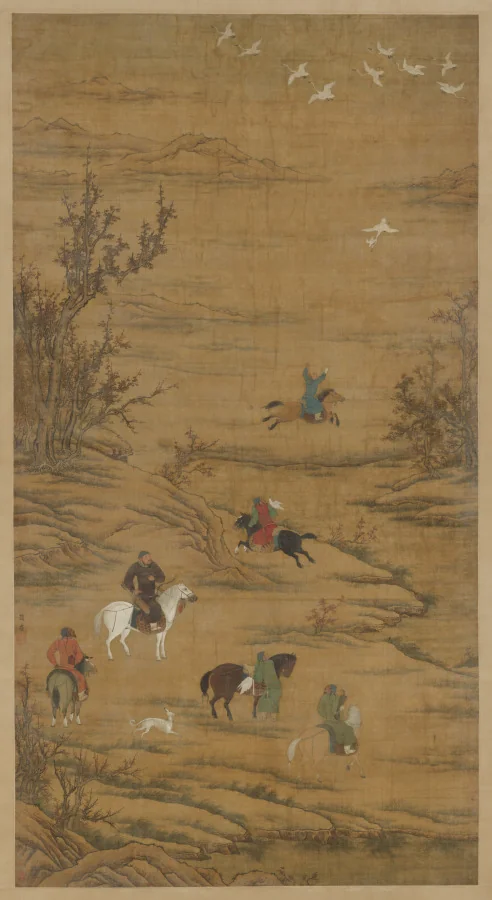
This large-scale hanging scroll depicts a party hunting for waterfowl along a riverbank in the springtime. The leader is distinguished from the other five mounted hunters by his purple robe with golden dragon patterns and his white horse with a red tassel. He and his horse maintain still, dignified postures as a small white falcon captures one of the wild geese.
Equestrian pursuits and hunting were particularly popular among the Khitan (also spelled “Qidan”) and Jurchen, ethnic groups who lived along China’s northeastern border. Their nomadic lifestyle intrigued the Chinese court and inspired Chinese artists to develop a painting genre showing them hunting.
Equestrian pursuits and hunting were particularly popular among the Khitan (also spelled “Qidan”) and Jurchen, ethnic groups who lived along China’s northeastern border. Their nomadic lifestyle intrigued the Chinese court and inspired Chinese artists to develop a painting genre showing them hunting.
Provenance
(Dr. John Calvin Ferguson [1866–1945], sold to the Cleveland Museum of Art) (?–1915); The Cleveland Museum of Art, Cleveland, OH (1915–)
Accession Number
1915.680
Medium
Hanging scroll; ink and color on silk
Dimensions
Painting: 276 x 147.5 cm (108 11/16 x 58 1/16 in.); Overall with knobs: 380 x 184 cm (149 5/8 x 72 7/16 in.)
Classification
Painting
Credit Line
Gift of the John Huntington Art and Polytechnic Trust
Tags
Painting Baroque (1600–1750) Ink Silk Painting Color: Gold
Background & Context
Background Story
Hunting on Horses from the c. 1600s-1700s is an anonymous Chinese painting depicting mounted hunters, a subject that reflects the enduring Chinese fascination with the hunting traditions of the northern nomadic peoples. The subject of hunting on horses—depicting mounted archers pursuing game across open terrain—was a popular court subject that reflected the Chinese court's interest in the military skills of the nomadic peoples, and the broad date range of the 1600s-1700s spans the Ming-Qing transition period when hunting subjects were particularly popular.
Cultural Impact
Hunting on Horses is important in the context of Chinese court painting because it demonstrates the enduring popularity of hunting subjects that reflected the Chinese court's interest in the military traditions of the northern nomadic peoples. Hunting subjects—depicting mounted archers pursuing game—were particularly popular during periods when the Chinese court was concerned with the military power of the nomadic peoples to the north, and the c. 1600s-1700s painting shows this tradition at its most characteristic.
Why It Matters
Hunting on Horses is an anonymous Chinese court painting: mounted hunters rendered in the tradition that reflected the Chinese court's enduring interest in the military skills of the northern nomadic peoples. The c. 1600s-1700s painting shows the hunting subject that was particularly popular during the Ming-Qing transition period.