Description
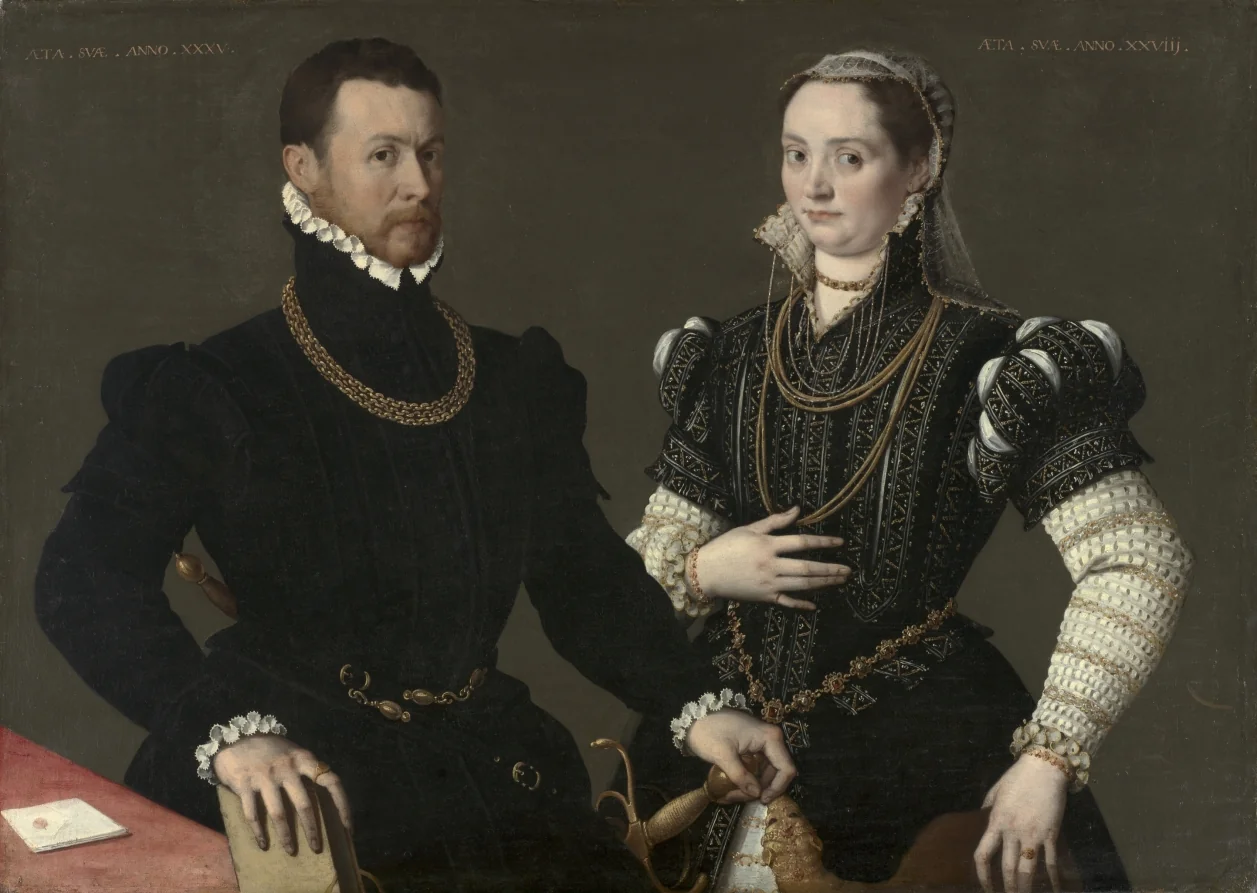
While the attribution remains hotly debated, this work exemplifies how Italian portraiture of the 1500s could articulate family alliances through marriage. The inscription gives the sitters’ ages as 35 and 28, and their elaborate jewelry, weapons, and garments, made of expensive materials, convey their elite status. The marten skin attached to the woman’s waist-its head decorated with gems-symbolized propriety. These expressions of wealth convey achievements and position rather than accurate personalities, and the figures, though lifelike, stand in awkward relationship to each other, their interaction one of alliance not love.
Provenance
James Jackson Jarves (1884).; Mrs. Liberty E. Holden, Cleveland.
Accession Number
1916.793
Medium
oil on canvas
Dimensions
Framed: 132 x 173 x 10.5 cm (51 15/16 x 68 1/8 x 4 1/8 in.); Unframed: 99.8 x 140.5 cm (39 5/16 x 55 5/16 in.)
Classification
Painting
Credit Line
Holden Collection
Tags
Painting Renaissance (1400–1599) Oil Painting Canvas Color: Black
Background & Context
Background Story
Portrait of a Couple, painted around 1580-1588, belongs to the tradition of Northern Renaissance portraiture that flourished in the late 16th century. The painting depicts a husband and wife, their faces and costumes rendered with the meticulous precision that distinguishes the finest Northern European portraiture.
Couples portraits of this period served both as records of specific individuals and as statements of social standing. The costumes, jewelry, and accessories that the sitters wear are not merely decorative but carry precise social meanings: they communicate the couple wealth, their social position, and their membership in a specific community. The Northern Renaissance portrait tradition, with its attention to the textures of fabric, skin, and metal, was the most technically accomplished portrait tradition in 16th-century Europe.
The painting most distinctive quality is its psychological precision. The unknown painter has captured not only the physical appearance of his sitters but something of their inner character: the husband authority, the wife composure, and the relationship between them - a partnership of social equals that the double-portrait format itself asserts. The tradition of the couples portrait, which presents marriage as a partnership of equals, is one of the most progressive conventions of Northern Renaissance art.
Cultural Impact
Northern Renaissance couples portraits established the tradition of the double portrait that would influence Rembrandt, Rubens, and the entire subsequent tradition of marital portraiture. Their combination of physical precision and psychological insight created a standard of portraiture that remains the foundation of the Western portrait tradition.
Why It Matters
This portrait captures the Northern Renaissance at its most intimate: a husband and wife, painted with a precision that reveals not only their faces but their partnership. The couple, gazing at the viewer across four centuries, are both specific historical individuals and archetypes of the marriage bond that was the foundation of Northern European society.