Description
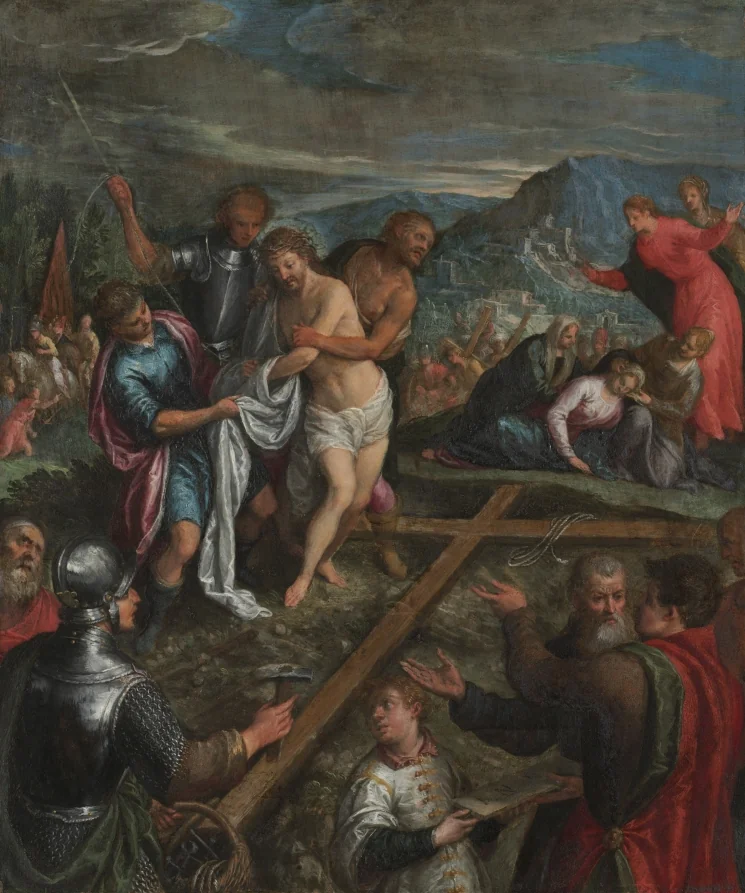
Despite the religious subject, the scale and intricate detail indicate that this painting was not for a church setting. Instead, as an independent work of art, a collector would have admired its artistry and unusual combination of Italian and northern European traditions. Likewise, the subject’s novelty would have intrigued a sophisticated patron. Neither Christ’s disrobing before the Crucifixion nor the debate over the plaque identifying him as Jesus of Nazareth, King of the Jews, are common subjects in the Renaissance. Who made this work remains a mystery. The copper surface, complex composition, and atmospheric landscape imply a painter from north of the Alps, as does Christ’s sinuous body. However, the drapery, rich colors, and figures at lower right stem from Venetian Renaissance art.
Provenance
James Jackson Jarves (1818–1888), Florence, Italy; Mrs. Liberty E. Holden (1838-1932), Cleveland, Oh, by gift to the Cleveland Museum of Art (1884-1916); The Cleveland Museum of Art, Cleveland, OH (1916-)
Accession Number
1916.816
Medium
oil on copper
Dimensions
Framed: 73.5 x 63.5 x 6.4 cm (28 15/16 x 25 x 2 1/2 in.); Unframed: 55 x 46.2 cm (21 5/8 x 18 3/16 in.)
Classification
Painting
Credit Line
Holden Collection
Tags
Painting Baroque (1600–1750) Oil Painting Copper Color: Orange Color: Brown
Background & Context
Background Story
Preparation for the Crucifixion from the early 1600s is an anonymous Netherlandish painting depicting the biblical episode in which Christ is prepared for his crucifixion, rendered in the detailed, devotional manner that distinguish the best Netherlandish religious painting of the period. The early 1600s date places this in the period when Netherlandish painting was producing some of its most accomplished religious subjects, and the anonymous painting maintains the detailed, devotional manner of the Netherlandish tradition.
Cultural Impact
Preparation for the Crucifixion is important in the context of Netherlandish religious painting because it demonstrates the detailed, devotional manner that the Netherlandish tradition maintained throughout the early 1600s. The Netherlandish tradition of detailed, devotional religious painting—combining precise observation with religious feeling—was one of the most accomplished traditions in European painting, and the anonymous painting shows this tradition at a high level of accomplishment.
Why It Matters
Preparation for the Crucifixion is anonymous Netherlandish religious painting: the biblical episode rendered in the detailed, devotional manner that the Netherlandish tradition maintained throughout the early 1600s. The painting shows the combination of precise observation with religious feeling that made Netherlandish painting one of the most accomplished traditions in European art.