Description
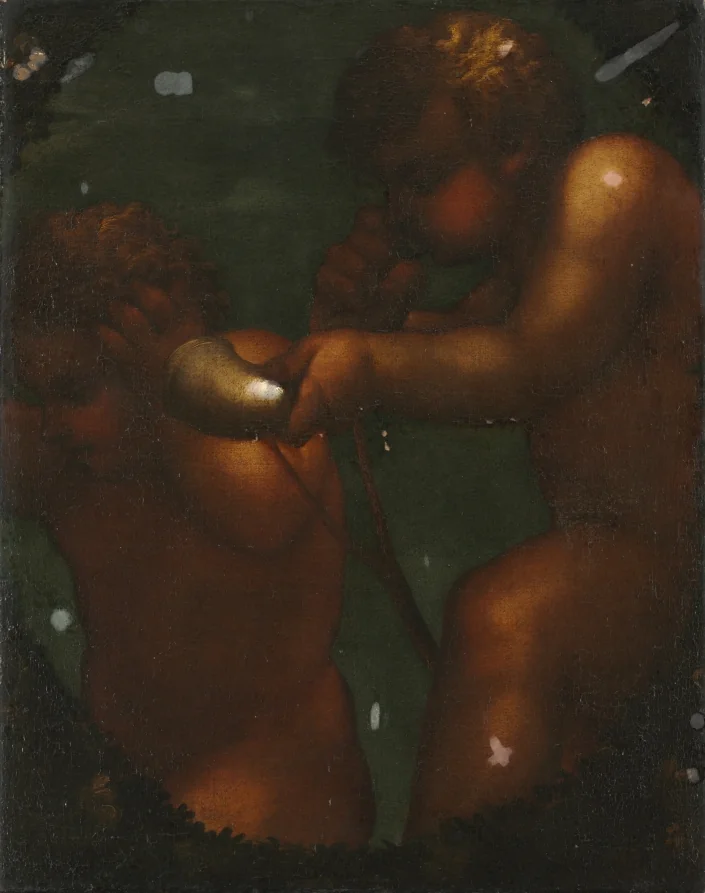
This painting depicts two playful putti, or cherub figures. One blows his horn into the other's ears; the other covers his ears to protect them. Now obscured by discolored varnish, the painting once had a greenish-blue background, now a mossy green. The pink flesh tones have turned bronze and the gray horn is now a brassy color. In 1519, Correggio painted playful putti in 16 oval ceiling frescoes in the Camera di San Paolo in Parma, Italy. These frescoes were commissioned by the Abbess Gioanna da Piacenza, as the room was her private quarters in the Benedictine nunnery of San Paolo. After the abbess's death, the house was strictly closed to the public for nearly two centuries. Thus Two Putti may be modeled after sketches of the frescoes made during the Abbess's lifetime, or, after the house reopened to the public, the artist may have admired the frescoes directly and modeled these putti after Correggio's originals.
Provenance
Cardinal Fesch, Palazzo Falconieri, Rome (?);; James Jackson Jarves;; Mrs. Liberty E. Holden, Cleveland, by gift to the Cleveland Museum of Art, 1916.
Accession Number
1916.966
Medium
oil on canvas
Dimensions
Framed: 138 x 114 x 10 cm (54 5/16 x 44 7/8 x 3 15/16 in.); Unframed: 103 x 81.5 cm (40 9/16 x 32 1/16 in.)
Classification
Painting
Credit Line
Holden Collection
Tags
Painting Baroque (1600–1750) Oil Painting Canvas Color: Orange
Background & Context
Background Story
Two Putti from the 1700s is an anonymous European painting depicting two putti—the chubby male children that were one of the most popular decorative subjects in European art from the Renaissance through the 18th century. The putto—or spiritello—originated in Italian Renaissance art as a small, winged or unwinged male child used as a decorative element, and became one of the most ubiquitous subjects in European decorative painting, sculpture, and graphic arts. The 1700s date places this in the period when putti were one of the most popular subjects in European decorative art, used in ceiling paintings, altarpieces, and decorative schemes throughout Europe.
Cultural Impact
Two Putti is an example of the putto tradition that was one of the most popular subjects in European decorative art from the Renaissance through the 18th century. The putto tradition—originating in Italian Renaissance art and spreading throughout Europe—represents one of the most enduring decorative subjects in Western art, and the 1700s painting shows this tradition at its most characteristic, when putti were used in virtually every type of European decorative painting.
Why It Matters
Two Putti is an anonymous 18th-century European painting: two chubby male children rendered in the putto tradition that was one of the most popular decorative subjects in European art from the Renaissance through the 18th century. The 1700s painting shows this enduring tradition at its most characteristic.