Provenance
Purchased by Langdon Warner [1881-1955], as agent of the Cleveland Museum of Art (1917); The Cleveland Museum of Art, Cleveland, OH (1917-)
Accession Number
1917.104
Medium
hanging scroll; ink on paper
Dimensions
Including mounting: 19.2 x 39.1 cm (7 9/16 x 15 3/8 in.)
Classification
Painting
Credit Line
Worcester R. Warner Collection
Tags
Painting Baroque (1600–1750) Ink Paper Color: Brown
Background & Context
Background Story
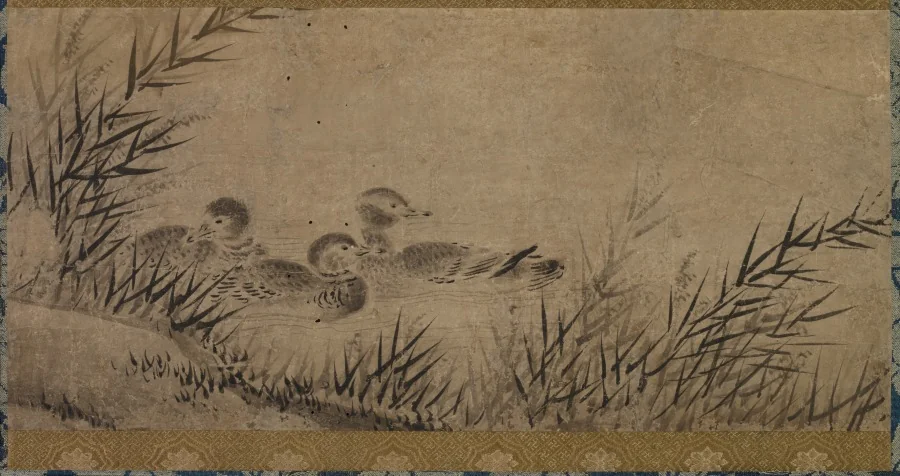
Ducks and Reeds from the early 1600s is an anonymous Japanese painting depicting ducks among reeds in the ink and color manner that distinguishes the best Japanese bird and flower painting of the early Edo period. The subject of ducks and reeds—combining the observation of nature with the philosophical ideal of retirement from the world—was one of the most traditional in Japanese painting, and the early 1600s date places this in the early Edo period when Japanese painting was developing its distinctive relationship with nature.
Cultural Impact
Ducks and Reeds is important in the context of Japanese bird and flower painting because it demonstrates the ink and color manner that distinguishes the best Japanese painting of the early Edo period. The subject of ducks and reeds—combining the observation of water birds with the atmospheric rendering of reeds and water—was one of the most traditional in Japanese painting, and the early 1600s painting shows this tradition at its most naturalistic and atmospheric.
Why It Matters
Ducks and Reeds is an anonymous early Edo bird and flower painting: ducks among reeds rendered in the ink and color manner that distinguishes the best Japanese painting of the period. The early 1600s painting shows the naturalistic observation of water birds combined with atmospheric rendering.