Description
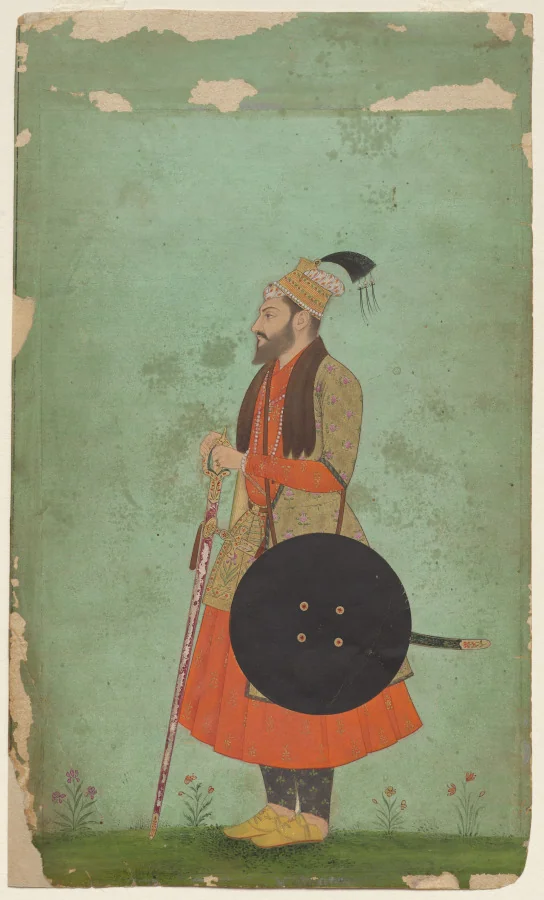
This portrait depicts the Mughal prince Murad Baksh in his early 30s, at the height of his power and promise. He wears a golden coat of honor with fur collar and the swords and shield of a military officer. As the youngest son of Emperor Shah Jahan, he was intimately involved in the struggles for succession. In 1658, he sided with his brother Aurangzeb (1618–1707) against their eldest brother, the crown prince, whom they defeated in a decisive battle that led to the crown prince’s eventual assassination in 1659. Aurangzeb then turned on his youngest brother, Murad Baksh himself, and had him imprisoned and finally executed in 1661.
Provenance
(Imre Schwaiger [1868–1940], London, UK, sold to the Cleveland Museum of Art) (?–1917); The Cleveland Museum of Art, Cleveland, OH (1917–)
Accession Number
1917.1066
Medium
Gum tempera and gold on paper
Dimensions
Overall: 20 x 12 cm (7 7/8 x 4 3/4 in.)
Classification
Painting
Credit Line
Gift of the John Huntington Art and Polytechnic Trust
Tags
Painting Baroque (1600–1750) Tempera Gold Leaf Paper Color: Orange Color: Green
Background & Context
Background Story
Portrait of Prince Murad Baksh from c. 1655 is an anonymous Mughal painting depicting the Mughal prince Murad Baksh (1624-1661), the youngest son of Shah Jahan, in the refined, naturalistic manner that distinguishes Mughal court portraiture at its most accomplished. The c. 1655 date places this during the reign of Shah Jahan (r. 1628-58), when Mughal painting was at its most refined and naturalistic. Prince Murad Baksh was an important Mughal prince who briefly claimed the throne during the war of succession that followed Shah Jahan's illness.
Cultural Impact
Portrait of Prince Murad Baksh is important in the history of Mughal painting because it demonstrates the refined, naturalistic portrait manner that distinguishes Shah Jahan-period painting from the more formal portraiture of earlier reigns. The c. 1655 portrait shows the Mughal court portrait tradition at its most refined—the naturalistic observation of the sitter's features combined with the decorative pattern that distinguishes Mughal portraiture from other portrait traditions.
Why It Matters
Portrait of Prince Murad Baksh is Shah Jahan-period Mughal portraiture at its most refined: the Mughal prince rendered with the naturalistic observation and decorative pattern that distinguish the best Mughal court portraits. The c. 1655 painting shows Mughal portraiture during the reign that produced the Taj Mahal—the most refined and naturalistic period of Mughal painting.