Provenance
Samuel Edward Raymond [1891–1976] and Jonathon S. Raymond [1894–1963], Cleveland, OH, given to the Cleveland Museum of Art (?–1917); The Cleveland Museum of Art, Cleveland, OH (1917–)
Accession Number
1917.889
Medium
gum tempera on cloth
Dimensions
N/A
Classification
Painting
Credit Line
Gift of Samuel Edward and Jonathan S. Raymond
Tags
Painting Baroque (1600–1750) Tempera Color: Orange
Background & Context
Background Story
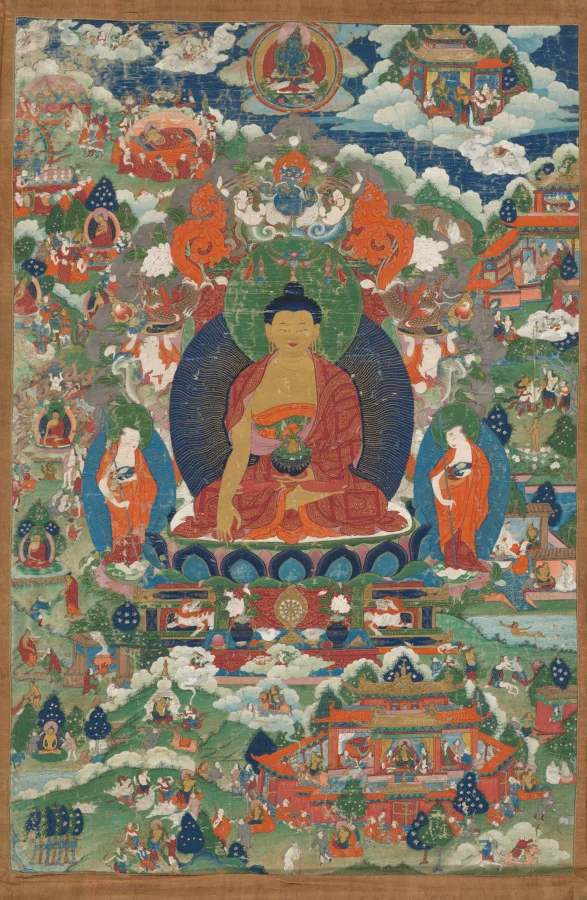
Mandara (pantheon) from c. 1700 is an anonymous Japanese Buddhist painting depicting the pantheon of Buddhist deities in the mandala format that is one of the most important types of Japanese Buddhist painting. The mandala format—arranging Buddhist deities in a hierarchical diagram that represents the Buddhist cosmos—was one of the most important types of Buddhist painting in Japan, used in meditation and ritual. The c. 1700 date places this in the Edo period, when Japanese Buddhist painting was producing some of its most accomplished mandalas in the colorful, elaborate manner that distinguishes the best Edo period Buddhist art.
Cultural Impact
Mandara (pantheon) is important in the history of Japanese Buddhist painting because it demonstrates the mandala format that is one of the most important types of Buddhist painting in Japan. The mandala—arranging Buddhist deities in a hierarchical diagram that represents the Buddhist cosmos—was used in meditation and ritual, and the c. 1700 mandala shows the colorful, elaborate manner of Edo period Buddhist painting applied to one of the most important formats in Buddhist art.
Why It Matters
Mandara (pantheon) is an anonymous Edo period Buddhist mandala: the pantheon of Buddhist deities arranged in the hierarchical diagram that represents the Buddhist cosmos. The c. 1700 painting shows the mandala format—one of the most important types of Buddhist painting in Japan—used in meditation and ritual.