Description
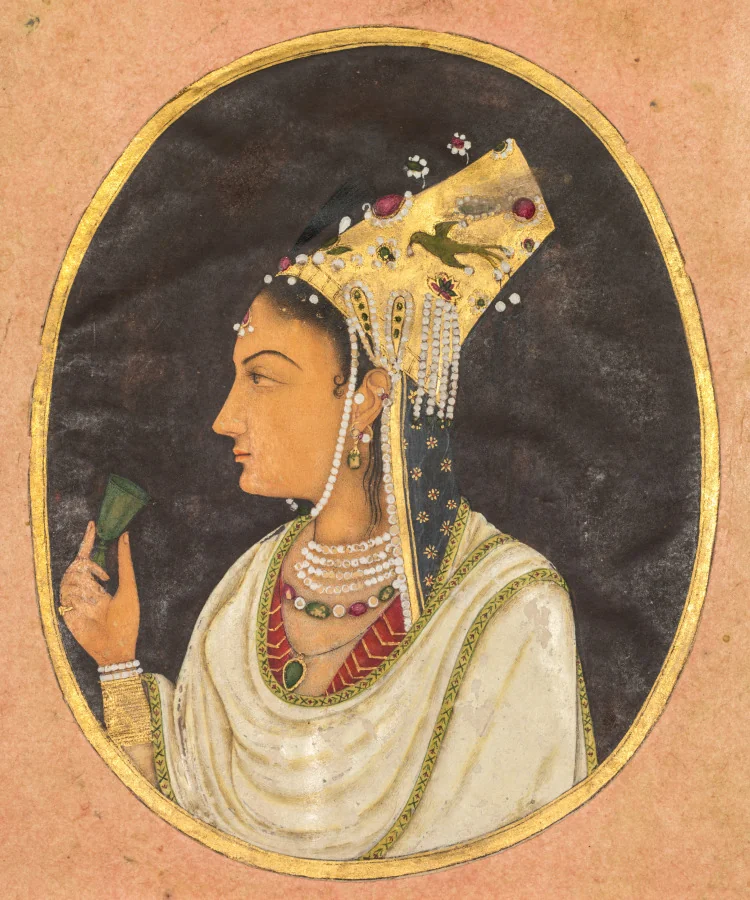
The tall, flat-topped hat is an element of the native dress of the Mughals from eastern Uzbekistan. Of mixed Turkic and Mongol ethnicities, they spoke a Turkic language known as Chaghatai. Chaghatai refers to the name of the son of the Mongol Chingiz (Genghis) Khan, who ruled this area of Central Asia from 1246 to 1282.
This woman’s hat has been studded with jewels and strings of pearls. The portrait jewel format that was once reserved for the emperor has now been expanded to include ladies of the court. The woman holds a jade wine cup and wears a draped upper garment with a woven or embroidered border similar to the fragment on display at the left.
This woman’s hat has been studded with jewels and strings of pearls. The portrait jewel format that was once reserved for the emperor has now been expanded to include ladies of the court. The woman holds a jade wine cup and wears a draped upper garment with a woven or embroidered border similar to the fragment on display at the left.
Provenance
[]
Accession Number
1920.1967
Medium
Gum tempera and gold on paper
Dimensions
Overall: 9.5 x 7.4 cm (3 3/4 x 2 15/16 in.)
Classification
Painting
Credit Line
Gift of J. H. Wade
Tags
Painting Baroque (1600–1750) Tempera Gold Leaf Paper Color: Orange
Background & Context
Background Story
This oval portrait of a woman in a Chaghtai hat is an anonymous work dating to approximately 1740-1750, depicting a female subject wearing the distinctive flat-topped headgear associated with the Chaghtai (or Chagatai) tradition of Central Asia. The Chaghtai hat, with its squared crown and upturned brim, was a marker of Central Asian and Turkic identity that became a recognizable element in Mughal and post-Mughal Indian painting, where it was used to identify figures of Central Asian heritage. The oval format of the portrait reflects the format commonly used in Mughal and provincial Mughal painting for individual portraits, a convention that was well established by the mid-18th century. The dating of this work to circa 1740-1750 places it in the period after the death of the Mughal emperor Muhammad Shah, when the empire was in steep political decline but Mughal artistic traditions were being maintained and transformed in the provincial courts of India. Portraits of women wearing Chaghtai hats appear in various schools of Indian painting, from the imperial Mughal workshop to the regional courts of Awadh, Hyderabad, and the Deccan. These portraits often depict women of Central Asian or Turkic descent, whose presence in India was a legacy of the Mughal dynasty's origins in Central Asia. The anonymous status of the work reflects the common practice in Indian painting of the period, where artists often did not sign their works, or where attributions have been lost over time. The portrait likely combines the refined technique of Indian miniature painting with the specific cultural coding of the Chaghtai hat, creating an image that simultaneously identifies the subject and places her within the complex cultural matrix of 18th-century India, where Central Asian, Persian, and indigenous traditions intermingled.
Cultural Impact
This portrait reflects the complex cultural intersections of 18th-century India, where Central Asian identity, marked by the Chaghtai hat, intersected with Mughal artistic traditions. Such portraits document the multicultural reality of the Mughal and post-Mughal courts, where heritage from Central Asia remained a marker of status and identity.
Why It Matters
This anonymous portrait preserves a visual record of Central Asian cultural identity within Mughal India, demonstrating how clothing and headgear carried specific cultural and ethnic meanings in 18th-century Indian art.