Provenance
[S. Mayer, Paris] (according to departmental card); Mr. Sizer (according to departmental card)
Accession Number
1927.337
Medium
pen and brown ink and brush and brown wash and watercolor, with gouache, over traces of graphite; framing lines in brown ink
Dimensions
Sheet: 24.9 x 24.7 cm (9 13/16 x 9 3/4 in.); Secondary Support: 45.1 x 33.9 cm (17 3/4 x 13 3/8 in.)
Classification
Drawing
Credit Line
Gift of The Print Club of Cleveland
Tags
Drawing Baroque (1600–1750) Watercolor Ink Graphite & Pencil Gouache Color: Gray
Background & Context
Background Story
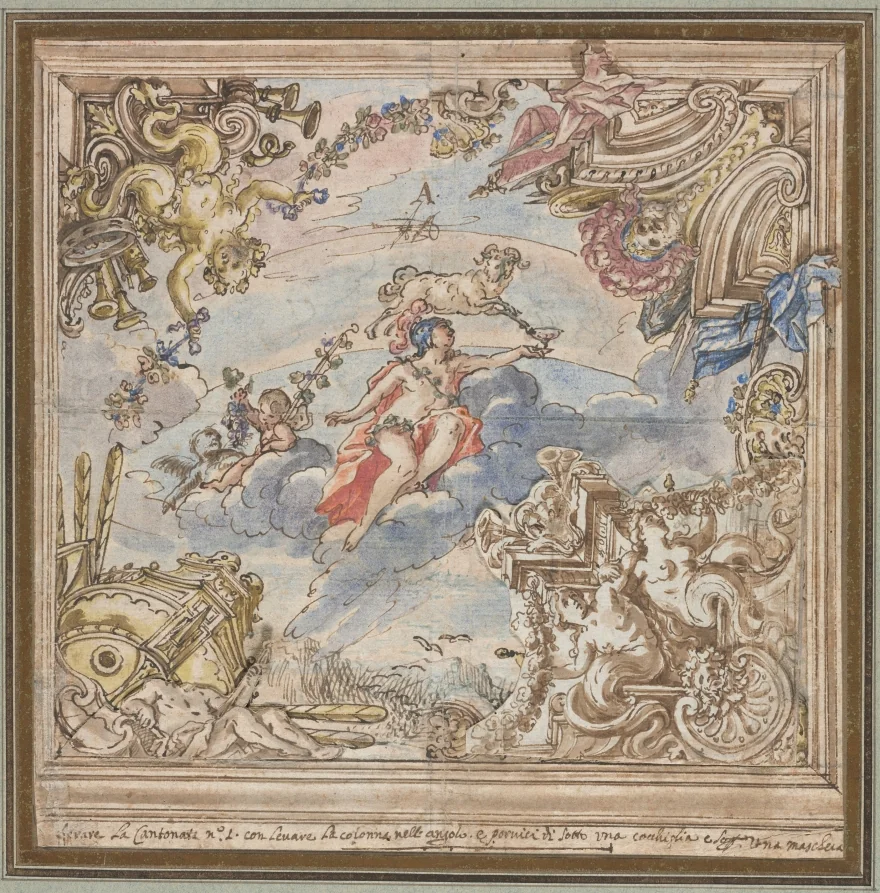
Design for a Ceiling: Mars and Aries is a decorative work from the 1700s attributed to an anonymous artist, reflecting the grand tradition of European interior decoration during the Baroque and Rococo periods. Ceiling paintings were among the most ambitious and spectacular forms of artistic expression in European palaces, churches, and noble residences, creating illusory openings to the heavens and overwhelming viewers with dramatic compositions. The subject—Mars, the Roman god of war, paired with Aries, the astrological sign associated with the same deity—connects the work to both classical mythology and astrological symbolism. This dual reference resonated deeply in an era when astrology and mythology were intertwined with political power, with rulers often identifying themselves with martial virtues and celestial favor. Ceiling designs of this period typically employed quadratura (illusionistic architecture) and di sotto in su perspective techniques to create the impression of looking upward into an open sky. The anonymous artist likely worked within a workshop tradition, where collaborative production was the norm and individual attribution was less important than collective craftsmanship. The 1700s saw the transition from exuberant Baroque to the lighter Rococo, and this design may reflect elements of both styles.
Cultural Impact
Ceiling decorations represent the pinnacle of Baroque artistic ambition, demonstrating how art, architecture, and mythology were combined to create immersive environments expressing political and spiritual power.
Why It Matters
This design exemplifies the anonymous workshop traditions that produced some of Europe's most spectacular decorative art, preserving the intersection of mythology, astrology, and architectural painting.