Description
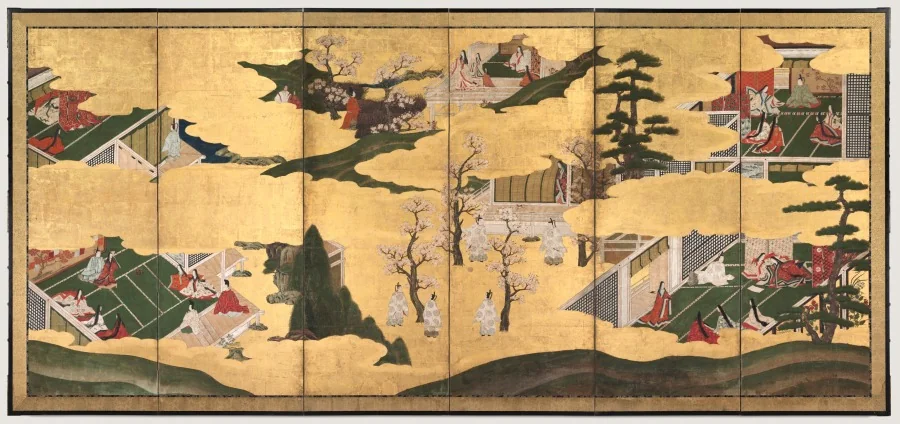
Folding screens served as temporary dividers in traditional Japanese open-plan architectural spaces. This pair was inspired by Japan’s most celebrated work of literature, the Tale of Genji, written by Murasaki Shikibu, an attendant to the empress in the early 11th-century imperial court. The novel follows the love life of the “Shining Prince” Genji and delves into the psychological states of his many companions. Distinct episodes are nestled within a matrix of golden clouds and landscape elements. Each screen includes six episodes presented in a nonlinear fashion, capturing scattered highlights of the story.
Provenance
William G. Mather [1857-1951], Cleveland, OH, given to the Cleveland Museum of Art (?-1948); The Cleveland Museum of Art, Cleveland, OH (1948-)
Accession Number
1948.124.2
Medium
One of a pair of six-panel folding screens; ink and color on gilded paper
Dimensions
Image: 154.5 x 351.2 cm (60 13/16 x 138 1/4 in.)
Classification
Painting
Credit Line
Gift of William G. Mather
Tags
Painting Baroque (1600–1750) Ink Panel Painting Paper Color: Orange Color: Gold
Background & Context
Background Story
Scenes from the Tale of Genji from the late 1700s depicts scenes from The Tale of Genji—the famous Japanese novel by Lady Murasaki Shikibu—in the elegantly composed manner of the Edo period painting tradition. The Tale of Genji is considered the world's first novel and is one of the most important works of Japanese literature, and paintings depicting scenes from it represent one of the most accomplished traditions in Japanese painting. The late 1700s date places this in the Edo period, when paintings of scenes from The Tale of Genji were being produced by some of the most accomplished painters of the Japanese tradition.
Cultural Impact
Scenes from the Tale of Genji is important in the history of Japanese painting because it demonstrates the tradition of depicting scenes from The Tale of Genji, one of the most important works of Japanese literature. The Tale of Genji—considered the world's first novel—is one of the most important works of Japanese literature, and paintings depicting scenes from it represent one of the most accomplished traditions in Japanese painting. The late 1700s painting shows this tradition in the Edo period.
Why It Matters
Scenes from the Tale of Genji is an anonymous Edo period painting: scenes from Lady Murasaki Shikibu's famous novel rendered in the elegantly composed manner of the Japanese painting tradition. The late 1700s painting shows the tradition of depicting The Tale of Genji that is one of the most accomplished traditions in Japanese painting.