Provenance
Emery May Holden Norweb [1895–1984], Cleveland, OH, given to The Cleveland Museum of Art, Cleveland, OH (?–1954); The Cleveland Museum of Art, Cleveland, OH (December 4, 1954–)
Accession Number
1954.708
Medium
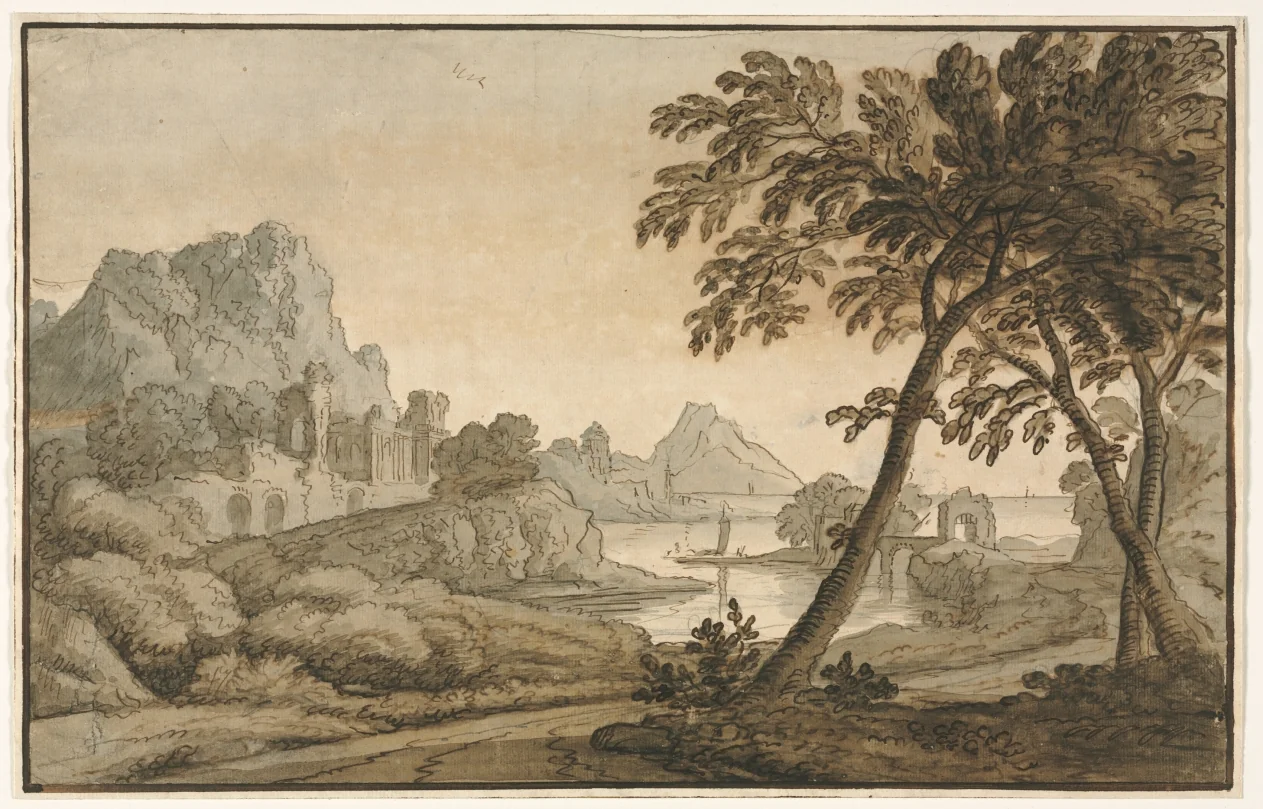
pen and brown ink, brown and gray wash, with graphite
Dimensions
Sheet: 24.5 x 38.3 cm (9 5/8 x 15 1/16 in.)
Classification
Drawing
Credit Line
The Norweb Collection
Tags
Drawing Baroque (1600–1750) Ink Graphite & Pencil Color: Brown Color: White
Background & Context
Background Story
Italian Landscape, dating from the 1700s and attributed to an unknown artist, represents one of the most enduring and influential subjects in European art. Italian landscape painting, whether produced by Italian artists or by the many Northern European painters who made the journey south, occupied a central position in the visual culture of the eighteenth century. The anonymous creator of this work participated in a tradition established by Claude Lorrain and Nicolas Poussin in the previous century that transformed the Italian countryside—from the Roman Campagna to the hills of Tuscany—into an idealized vision of pastoral harmony and classical beauty. The 1700s were the great age of the Grand Tour, when young aristocratic men from across Europe traveled to Italy to complete their education, and landscape paintings served as both souvenirs and status symbols. The conventions of Italian landscape painting—balanced compositions, warm golden light, architectural ruins framing distant views, and small figures providing scale and narrative interest—were so widely established that anonymous works of considerable skill and beauty were produced in large numbers to meet the demand. The anonymity of this work reflects the workshop system in which many such paintings were produced, where the name of the master or workshop was more important than individual attribution. Italian landscapes of this period shaped European taste for generations, establishing compositional conventions that would influence everything from garden design to photography.
Cultural Impact
Anonymous Italian landscapes of the 1700s sustained the Grand Tour market and established compositional conventions that defined European landscape taste for centuries, from garden design to tourist photography.
Why It Matters
This work represents the widespread tradition of Italian landscape painting that shaped European visual culture, demonstrating how conventions established by Claude and Poussin became a universal visual language of idealized nature.