Accession Number
1954.710
Medium
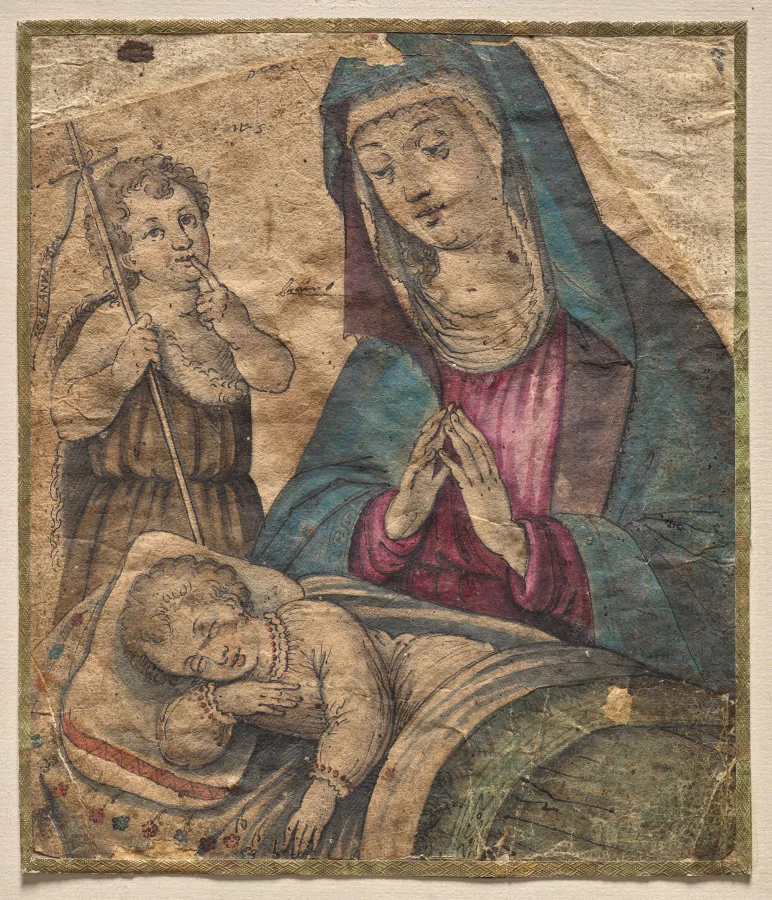
pen and black ink and brush and brown wash and blue, green, red and red-purple gouache
Dimensions
Sheet: 17.6 x 15 cm (6 15/16 x 5 7/8 in.); Secondary Support: 18.2 x 15.6 cm (7 3/16 x 6 1/8 in.); Tertiary Support: 18.2 x 15.6 cm (7 3/16 x 6 1/8 in.); Quadratic Support: 24.8 x 20.9 cm (9 3/4 x 8 1/4 in.)
Classification
Drawing
Credit Line
The Norweb Collection
Tags
Drawing Renaissance (1400–1599) Ink Gouache Color: Orange Color: Brown
Background & Context
Background Story
Virgin and Child with Saint John (recto) and an Unidentifiable subject (verso), dating from the 1500s and attributed to an unknown artist, represents one of the most fundamental subjects in Western art: the Madonna and Child accompanied by the young Saint John the Baptist. This composition, which originated in Florentine Renaissance workshops and spread throughout Europe,depicts the intimate relationship between the Virgin Mary, the infant Jesus, and John the Baptist—two children whose destinies were intertwined by Christian theology. The inclusion of Saint John the Baptist was particularly meaningful in Florence, where he was the patron saint, but the composition became universal in its appeal, symbolizing divine love, maternal tenderness, and the prophetic recognition of Christ's mission even in childhood. The 1500s saw this subject rendered in countless variations, from the monumental compositions of Raphael to more intimate devotional works intended for private chapels and homes. The fact that this work has a verso (reverse side) with another subject suggests it may have been a preparatory drawing, a double-sided panel, or a work that was painted on both sides for practical or economic reasons. Such dual-sided works provide valuable insight into artistic practice, revealing how artists explored different ideas on available surfaces and how works were valued differently across centuries.
Cultural Impact
Double-sided works from the 1500s offer rare insight into artistic workshop practices, revealing how Renaissance artists maximized available materials and how devotional subjects were created for different contexts and purposes.
Why It Matters
This work preserves both a canonical Renaissance devotional subject and evidence of sixteenth-century artistic practice, offering insight into how Renaissance workshops efficiently used available materials.