Description
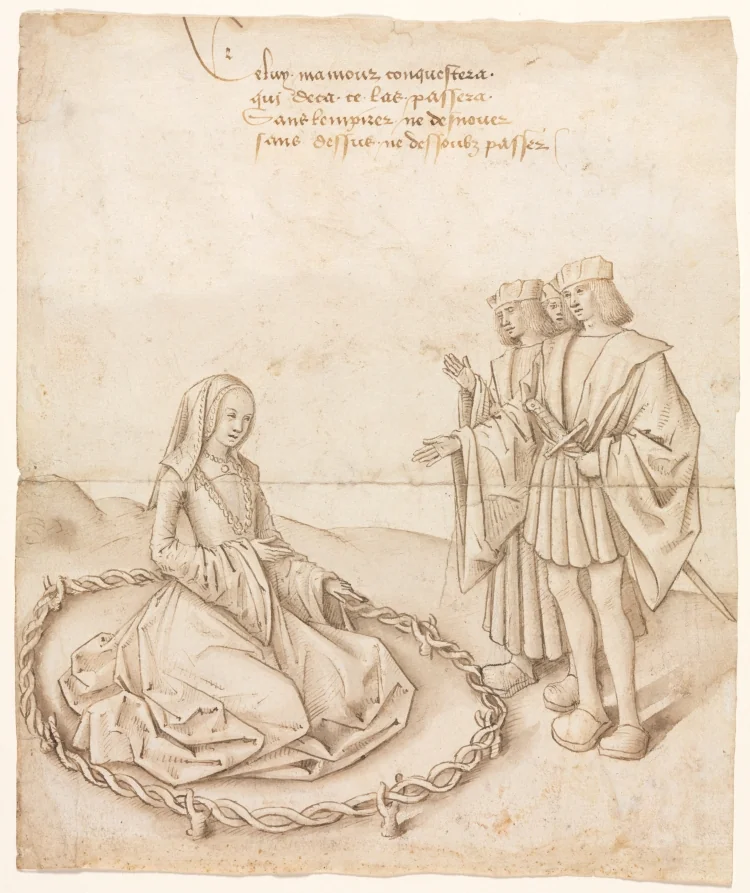
This mysterious drawing shows an encounter between elegantly dressed members of the noble class. The French inscription above the image suggests that the woman is addressing her suitors and makes it clear that they are concerned with the pursuit of love: He who will conquer my love / This [barrier] must overcome / Neither destroying it nor loosening it / Going neither below it nor above. The style of the clothing reflects French court fashions during the reign of Charles VIII (1483–98), and the subject relates to the tradition of late medieval collections of love riddles that involved verbal exchanges between courtly ladies and gentlemen.
Provenance
Antonio Badile II [1424-1507], Verona (?-probably by 1507); Ludovico Moscardo, Verona (?-?); Teresa Moscardo [1747-?], Verona, by descent (?-?); Count Mario Miniscalchi-Erizzo [1881-1957], Verona, by descent (?-around 1905); with Francis Matthiesen, London (around 1954-1956); The Cleveland Museum of Art, Cleveland, OH (1956-)
Accession Number
1956.40
Medium
pen and brown ink, brush and brown wash, with traces of black chalk
Dimensions
Sheet: 23 x 19.3 cm (9 1/16 x 7 5/8 in.)
Classification
Drawing
Credit Line
John L. Severance Fund
Tags
Drawing Renaissance (1400–1599) Ink Color: White Color: Gray
Background & Context
Background Story
A Lady with Three Suitors from c. 1500 is an Indian painting depicting a lady with three suitors, following the long Indian tradition of painting scenes of courtship and romance that is one of the most important genres in Indian painting. The c. 1500 date places this in the early period of Indian court painting, when the tradition of painting scenes of courtship and romance was being developed in the courts of the Rajput kingdoms and the Sultanate of Delhi, and the lady with three suitors subject connects the painting to the long Indian tradition of depicting the dynamics of romantic love in South Asian art.
Cultural Impact
A Lady with Three Suitors is important in the history of Indian painting because it demonstrates the tradition of painting scenes of courtship and romance that is one of the most important genres in Indian painting. The tradition of depicting the dynamics of romantic love—with its themes of longing, separation, and union—is one of the most enduring subjects in Indian art, and the c. 1500 painting shows this tradition in its early period of development.
Why It Matters
A Lady with Three Suitors is an Indian painting from c. 1500 depicting a lady with three suitors in the courtship tradition that is one of the most important genres in Indian painting. The painting shows the early development of the romantic love tradition that would become one of the most enduring subjects in Indian art.