Provenance
Painted for the sitter's first husband, Thomas Scott Jackson [d. 1791]; by descent to the sitter's daughter, Maria [d. 1830], who married Sir John Grey-Egerton, 8th Bt. of Oulton; by descent to Sir Philip Grey-Egerton, 12th Bt. [1864-1937]; sold c. 1905 to (Thos. Agnew & Sons, London). (Robert Langton Douglas (1864-1951), London); [1] purchased by J. Pierpont Morgan, Sr. [1837-1913], New York; bequeathed to his daughter, Juliette [Mrs. William P. Hamilton], New York; sold December 1936 to The A.W. Mellon Educational and Charitable Trust, Pittsburgh; gift 1937 to NGA.
[1] See letter from Douglas to Fowles dated 1 May 1941, Duveen Brothers Records, Box 244 (reel 299).
Accession Number
1937.1.94
Medium
oil on canvas
Dimensions
overall: 239 x 147 cm (94 1/8 x 57 7/8 in.)
Classification
Painting
Credit Line
Andrew W. Mellon Collection
Tags
Painting Neoclassical & Romantic (1751–1850) Oil Painting Canvas British
Background & Context
Background Story
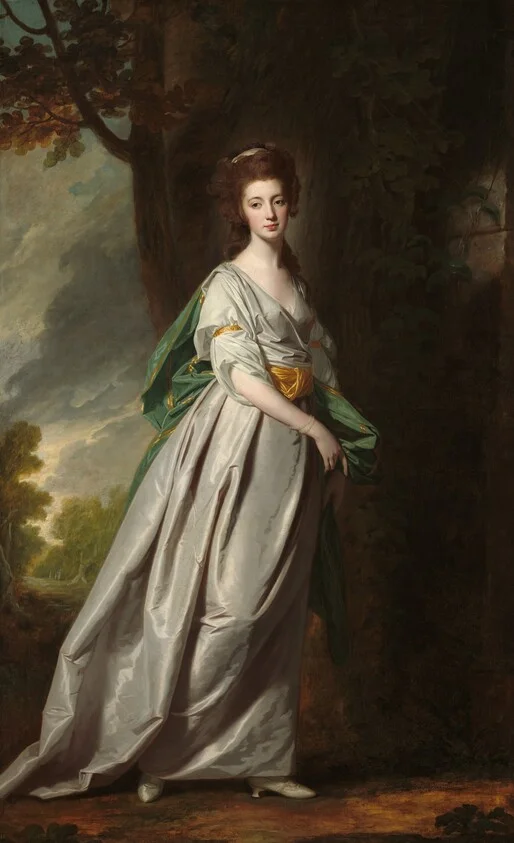
Mrs. Thomas Scott Jackson (c. 1770/1773) is an early portrait from Romney's London period, depicting a young married woman with the freshness and directness that characterized his best early work. The portrait dates from the years when Romney was establishing his London practice, having moved from the north of England to seek the metropolitan patronage that would make him wealthy and famous. The 1770-73 dating places this during Romney's transition from northern provincial painter to London society portraitist—a career trajectory that required him to adapt his style to the more sophisticated expectations of the capital's clientele. Mrs. Jackson's portrait demonstrates the qualities that attracted London patronage: the fluent brushwork, the ability to capture individual character, and a freshness that distinguished Romney's work from the more established practices of Reynolds and Gainsborough. The portrait also reflects the 1770s social context—a period of expanding prosperity and cultural confidence in Britain that would produce the great age of Georgian portraiture. Mrs. Jackson's attire and demeanor embody the prosperous middle class whose growing wealth and cultural aspirations drove the portraiture market.
Cultural Impact
Romney's early London portraits influenced how provincial artists could successfully transition to metropolitan practice, establishing a model of stylistic adaptation that later artists followed. The portraits documented the expanding British middle class—their increasing wealth, cultural aspirations, and desire for visual representation. Mrs. Jackson's portrait specifically influenced how middle-class women's portraiture was understood, establishing conventions of freshness and personal presence that distinguished this social tier's representation from aristocratic formality.
Why It Matters
This portrait matters because it captures a moment of social and artistic transition—the moment when a provincial painter became a London success, and when middle-class patronage began to rival aristocratic patronage as the engine of British portraiture. For contemporary artists building careers, Romney's trajectory offers both inspiration and practical insight into how artistic quality can drive social mobility.